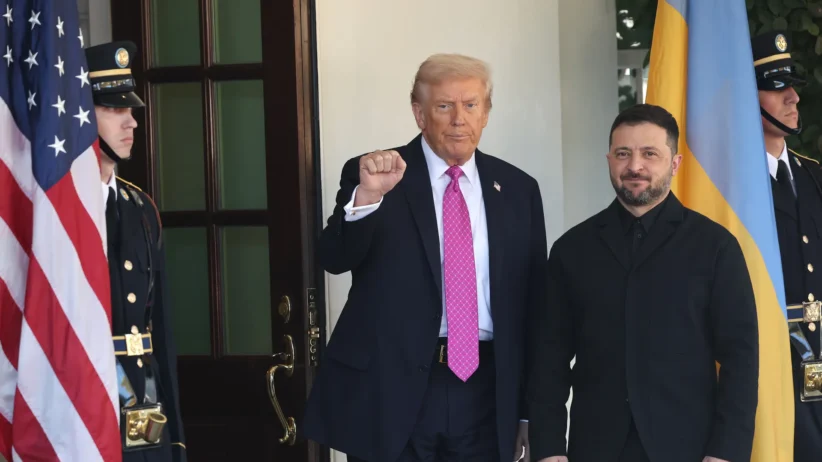
November 23, 2025 | Geneva, Switzerland, In a high-stakes diplomatic push that could reshape Europe’s security landscape and ripple across global energy markets, U.S., Ukrainian, and European officials convened in Geneva today for closed-door talks on President Donald Trump’s ambitious 28-point peace plan to end Russia’s three-year invasion of Ukraine.
By Qamar Farooqui | International Desk
The meetings, hosted at the United Nations’ European headquarters, mark the first formal multilateral engagement since Trump’s re-election and come amid mounting pressure on Kyiv to accept terms that include territorial concessions and a temporary pause on NATO membership aspirations.
As delegations from the U.S. State Department, Ukrainian Foreign Ministry, and EU foreign affairs representatives huddle behind neutral Swiss doors, the world watches closely. President Trump, in a fiery Truth Social post late Friday, issued an ultimatum to Ukrainian President Volodymyr Zelenskiy: approve the plan by Thursday or risk a U.S. aid freeze. “Ukraine has been ungrateful for America’s generosity—time to make peace, not war,” Trump wrote, echoing sentiments from his campaign trail where he promised to resolve the conflict “in 24 hours.”
The Proposal Breakdown: A 28-Point Roadmap to Ceasefire?
At its core, Trump’s plan—leaked in parts to Western media over the weekend—envisions a multi-phased de-escalation. Key elements include:
- Territorial Compromises: Ukraine would cede control of Crimea (annexed by Russia in 2014) and parts of Donetsk and Luhansk oblasts to Moscow in exchange for a demilitarized buffer zone along the pre-2022 border. This addresses Russia’s “red lines” but has drawn sharp criticism from Kyiv as a “surrender of sovereignty.”
- NATO Freeze: A 10-year moratorium on Ukraine’s NATO accession, coupled with neutral status guarantees monitored by UN peacekeepers. European allies, particularly Poland and the Baltics, view this as a concession to Russian President Vladimir Putin, potentially emboldening further aggression in Eastern Europe.
- Economic Incentives: Reconstruction aid totaling $500 billion, split between U.S./EU contributions and frozen Russian assets. Sanctions on Moscow would ease gradually if compliance is verified, aiming to stabilize global food and energy supplies disrupted since February 2022.
- Security Guarantees: Bilateral defense pacts for Ukraine with the U.S. and UK, excluding offensive capabilities. Zelenskiy, in a pre-talks address, lamented the “ongoing Russian barbarity” but signaled openness to “pragmatic compromises” if they include ironclad protections against future incursions.
U.S. Secretary of State Marco Rubio, leading the American delegation, described the talks as “constructive but tense,” emphasizing that the plan is not a “final offer” but a “starting point for real peace.” Ukrainian Foreign Minister Dmytro Kuleba echoed cautious optimism, noting European officials’ role in “safeguarding Kyiv’s red lines.”
Economic Fallout: Oil Prices Plunge 5% Amid Ceasefire Hopes
The mere announcement of these talks has already jolted markets. Brent crude futures dipped 5% to $72 per barrel in early Asian trading today—the lowest since mid-2023—on speculation of resumed Russian exports through Ukraine’s pipelines. Wheat prices, a staple in global food security, fell 3%, alleviating fears of another “Black Sea blockade” crisis that spiked inflation worldwide in 2022-23.
For the 8 billion people on Earth, this isn’t abstract diplomacy: the war has already claimed over 500,000 lives, displaced 10 million, and added $2 trillion to global economic costs through energy shocks and supply chain snarls. A swift resolution could unlock $1 trillion in frozen trade, but failure risks escalation, including nuclear saber-rattling from Moscow.
India’s Stake: A Diplomatic Windfall in a Multipolar World
From New Delhi’s vantage point, the Geneva summit is a double-edged sword. India, which has maintained a neutral stance—abstaining from UN votes condemning Russia while providing humanitarian aid to Ukraine—stands to gain significantly from de-escalation. As the world’s third-largest oil importer, India sourced 40% of its crude from Russia in 2024 at discounted rates, saving an estimated $10 billion annually. A stable Ukraine could further lower prices by 10-15%, easing inflation in a nation where fuel costs ripple through everything from Mumbai taxis to Bihar’s farms.
Yet, risks loom. Ceding territory might embolden China in the South China Sea or along the LAC with India, testing Modi’s “multi-alignment” foreign policy. External Affairs Minister S. Jaishankar, speaking at a Delhi think tank yesterday, urged “pragmatic peace without capitulation,” positioning India as a potential bridge-builder between the Global South and Western powers. With BRICS partners Russia and China watching closely, New Delhi could leverage its G20 presidency experience to mediate post-talks implementation, enhancing its soft power in Eurasia.
Moreover, a NATO pause might indirectly benefit India’s QUAD alliances with the U.S., Japan, and Australia, freeing Washington to pivot toward Indo-Pacific threats. Indian diaspora communities—over 1 million in Ukraine and Russia—also breathe easier at the prospect of family reunifications and halted bombardments.
Conclusion: Ceasefire by Christmas, or Stalemate into 2026?
As the Geneva curtains draw on Day 1, optimism tempers realism. Analysts predict a 60% chance of a framework agreement by December, but Zelenskiy’s domestic politics—polls show 70% opposition to concessions—could derail it. Trump, ever the dealmaker, has hinted at personal calls to Putin if needed, but European skepticism (with Germany and France pushing for “Ukraine-first” tweaks) adds layers of complexity.
For the world, this isn’t just about borders—it’s a test of post-Cold War order. A successful plan could herald a “Pax Americana 2.0,” stabilizing energy for billions and curbing nuclear brinkmanship. Failure, however, invites chaos, from refugee waves to proxy conflicts in Africa and Asia.
India, with its balanced diplomacy, is uniquely placed to amplify Global South voices in this equation. As Jaishankar quipped, “Peace is not zero-sum—it’s the dividend we all share.” Watch Geneva closely; the ripples will reach Delhi, and beyond.
Qamar Farooqui is Editor-in-Chief at News360.Live Follow for more on global affairs from an Indian lens. Share your thoughts: Will Trump’s plan deliver lasting peace? Comment below.