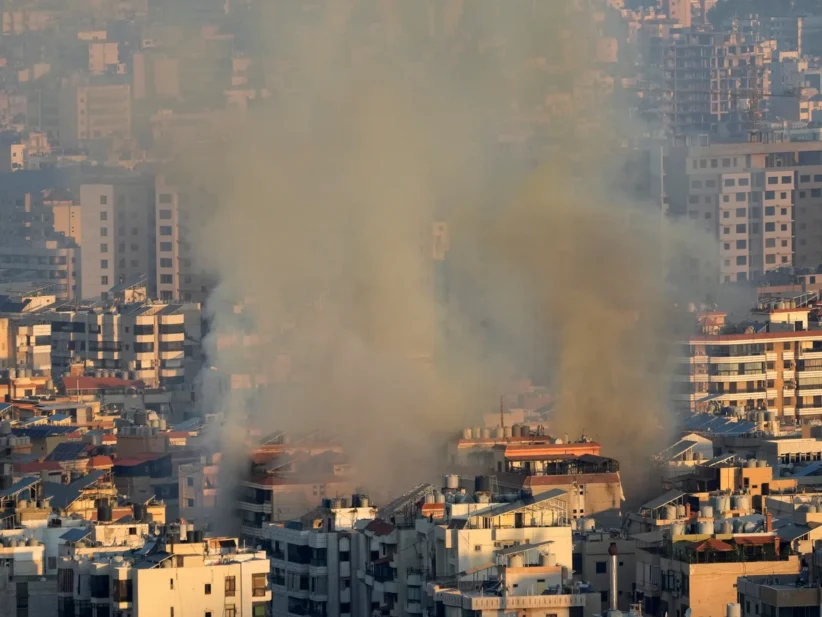
November 23, 2025 | Beirut, Lebanon. In a dramatic escalation that shatters months of fragile calm along the Israel-Lebanon border, Israeli warplanes launched precision airstrikes on Beirut’s southern suburbs early Saturday, assassinating a senior Hezbollah commander in what Tel Aviv called a “preemptive strike against imminent threats.
By Qamar Farooqui, International Desk
” The attack, the first major incursion into Lebanon’s capital since the October 2023 Gaza war spillover, has killed at least 12 people—including the target, Hezbollah’s Ali Kamel Labwani—and injured over 50, according to Lebanese health officials. Hezbollah vowed “severe retaliation,” raising fears of a full-scale regional conflagration that could draw in Iran, Syria, and even U.S. forces in the Gulf.
The Israeli Defense Forces (IDF) confirmed the operation in a terse statement, claiming Labwani—a key operative in Hezbollah’s rocket program—was planning attacks on northern Israeli communities from his Dahiyeh stronghold. “This was not aggression; it was necessity to protect our citizens,” IDF spokesperson Brig. Gen. Effie Defrin told reporters in Tel Aviv. Satellite imagery from Reuters shows smoke rising from a multi-story building reduced to rubble, with secondary explosions suggesting munitions caches were hit.
This strike ends a four-month lull in cross-border exchanges that had seen daily tit-for-tat fire since Hezbollah joined the fray in solidarity with Hamas post-October 7, 2023. Over 500 Lebanese and 40 Israelis have died in those skirmishes, displacing 100,000 on both sides. But Beirut’s involvement signals a dangerous pivot: urban warfare in a densely populated city of 2 million, risking civilian catastrophe on a scale unseen since the 2006 Israel-Hezbollah war.
Timeline of Escalation: From Gaza Shadows to Beirut’s Streets
The roots trace back to the Gaza conflict, but recent triggers abound:
- October 2023: Hezbollah launches rockets in support of Hamas, prompting IDF ground incursions into southern Lebanon.
- June 2024: U.S.-brokered ceasefire holds tenuously, with UNIFIL monitors reporting 200+ violations monthly.
- November 2025: Intelligence intercepts reveal Iranian-supplied drones en route to Hezbollah via Syria, per Israeli sources. Labwani, sanctioned by the U.S. in 2022 for “terror financing,” was allegedly coordinating these transfers.
Lebanese Prime Minister Najib Mikati condemned the strikes as “a violation of sovereignty,” calling an emergency cabinet session. Hezbollah leader Hassan Nasrallah, in a rare audio message, decried the “Zionist assassination” and promised “operations that will make rivers of blood flow,” evoking fears of the 1982 Beirut siege that killed 20,000.
Humanitarian Crisis: Beirut’s Displacement Wave and Global Repercussions
The immediate toll is grim: Over 5,000 residents fled Dahiyeh overnight, overwhelming shelters in central Beirut. The UN’s OCHA warns of a “humanitarian tipping point,” with Lebanon’s economy—already shattered by 2020’s port blast and hyperinflation—facing $500 million in reconstruction costs. Water and power outages compound the chaos, as Hezbollah’s embedded infrastructure (hospitals, schools) often doubles as military sites, blurring civilian-military lines.
Globally, the stakes are stratospheric. The strikes threaten the Strait of Hormuz and Red Sea shipping lanes, through which 20% of world oil flows. Brent crude surged 3% to $78 per barrel today on “geopolitical risk premiums,” per Bloomberg data. Airlines like Emirates and Qatar Airways suspended flights to Beirut, stranding 10,000 passengers. For the 2 billion people in energy-importing nations, sustained escalation could add $0.50 per liter to fuel prices, fueling inflation from Delhi to Detroit.
India’s Balancing Act: Diaspora, Diplomacy, and Defense Ties
For India, this is personal and strategic. With 1.5 million expatriates in Lebanon and Gulf states, New Delhi evacuated 500 citizens last night via special Air India flights from Amman. External Affairs Minister S. Jaishankar, in a Lok Sabha briefing, urged “restraint from all parties” while reaffirming India’s “ironclad” defense ties with Israel—$2 billion in annual arms imports, including drones used in such operations.
Yet, New Delhi’s outreach to Iran (Chabahar port deal) and Syria complicates matters. A wider war could spike oil imports by 15%, hitting India’s $100 billion annual bill and exacerbating domestic fuel hikes. Prime Minister Modi, speaking at the G20 sidelines, positioned India as a “voice of moderation,” offering mediation through its UN Security Council bid. The Indian diaspora—tech workers in Beirut, laborers in Gulf—faces evacuation risks, echoing the 2020 Yemen crisis that airlifted 4,000.
Moreover, Hezbollah’s Iranian backing raises shadows over Indo-Iranian projects, while Israeli tech (cyber/intel) bolsters India’s counter-terror grid. Analysts at ORF Delhi warn: “A Lebanon flare-up could pull India into proxy debates, diluting focus on China.”
Conclusion: Brink of Wider War, or Room for De-Escalation?
As Hezbollah masses rockets along the Litani River and Israel mobilizes reserves, the UN Security Council convenes urgently Monday. U.S. President Biden, balancing Trump’s incoming team, called Netanyahu to “de-escalate,” but veto power dynamics favor restraint over resolution. Iranian Foreign Minister Abbas Araghchi labeled the strike “state terrorism,” hinting at asymmetric responses via proxies in Iraq and Yemen.
For the world, Beirut’s bombardment isn’t isolated—it’s a fuse in a powder keg linking Gaza, Syria, and the Gulf. A regional war could displace 5 million, cost $1 trillion in trade disruptions, and ignite proxy battles worldwide. Yet, quiet Gulf diplomacy (UAE-Qatar backchannels) offers glimmers of hope.
India, with its multi-faith mosaic and non-aligned ethos, must navigate this tightrope. As Jaishankar noted, “Stability in West Asia is India’s oxygen.” The coming 72 hours will test that breath—will Beirut burn, or can cooler heads prevail?
Qamar Farooqui is Editor-in-Chief at News360 Live. Follow for unfiltered global insights from an Indian perspective. Share your views: Is escalation inevitable? Comment below.